Invisible Leaks: How Exchange Liquidity Silently Erodes Your Crypto Returns
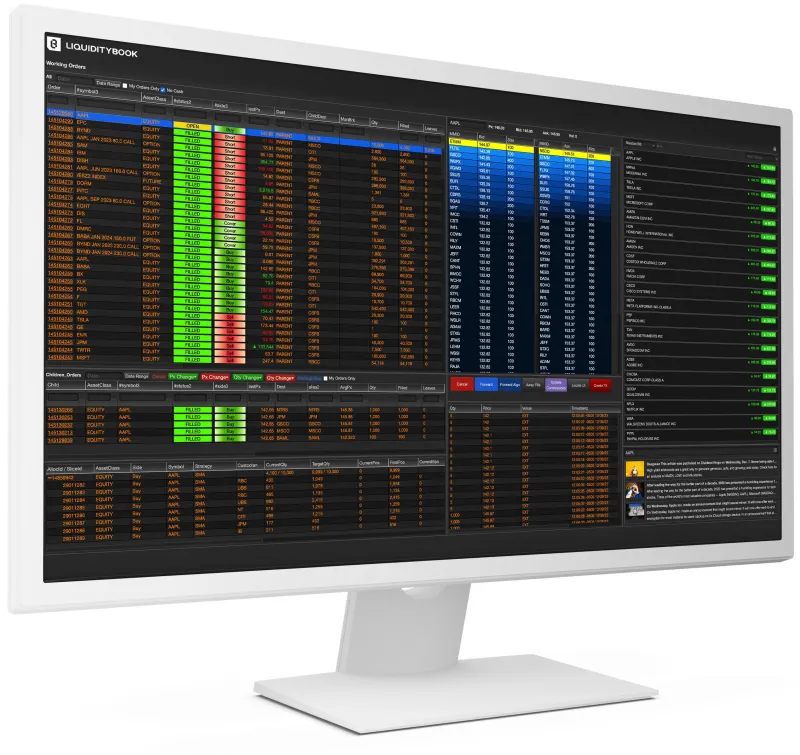
Photo: cryptocurrency exchange order book trading screen liquidity, via www.liquiditybook.com
Pick the right coin. Time the market. Execute the trade. For many retail investors, that three-step formula represents the entire trading playbook. Yet there is a fourth variable — one that operates entirely in the background — that can quietly neutralize even the most carefully researched position. That variable is liquidity, and understanding it is not optional for anyone serious about building consistent returns in digital asset markets.
What Liquidity Actually Means in a Crypto Context
At its most fundamental level, liquidity describes how easily an asset can be bought or sold without meaningfully moving its price. In traditional equity markets, institutional market makers and regulated exchanges maintain relatively tight bid-ask spreads on major stocks. Crypto markets operate differently. Liquidity is fragmented across dozens of centralized exchanges, each with its own order book, its own pool of active traders, and its own depth at any given price level.
When a platform carries high liquidity, there are enough buyers and sellers stacked at successive price points that a reasonably sized order can be filled close to the quoted price. When liquidity is thin, even a modest order can push the market against you before execution completes. That gap between the price you expected and the price you actually received has a name: slippage.
Slippage Is Not a Rounding Error
Many traders dismiss slippage as an unavoidable nuisance — a few basis points here and there. The reality is more consequential. Consider a trader placing a $20,000 market buy order on a mid-tier exchange where the order book thins out sharply above the best ask price. If the available liquidity at the quoted price covers only $8,000 of that order, the remaining $12,000 gets filled at progressively higher levels. On a volatile altcoin, that gap could represent a 1.5% to 3% adverse move before the order is even complete.
Now apply that math across a year of active trading. A trader executing twenty such transactions per month, each suffering 1.5% in average slippage, is surrendering roughly 18% in frictional costs annually — before accounting for exchange fees, spreads, or tax obligations. That is not a rounding error. That is a structural drain on capital.
Order Book Depth: The Metric Most Traders Never Check
The order book is the most honest document on any exchange. It shows exactly how many buy and sell orders exist at each price increment, giving a real-time picture of market depth. A deep order book — one with substantial volume stacked within a narrow range around the current price — signals a liquid market. A shallow book, where large gaps appear between price levels, signals the opposite.
Before executing any significant trade, particularly in assets outside the top ten by market capitalization, experienced traders on platforms like Exchange777 routinely examine order book depth rather than simply accepting the displayed spot price at face value. The spot price reflects only the last executed trade. The order book reveals what the next trade will actually cost.
Comparing Execution Across Exchange Tiers
The difference in execution quality between a high-volume, institutionally supported exchange and a lower-tier platform becomes most apparent during periods of market stress. During the sharp volatility events that have characterized crypto markets — sudden 10% to 15% moves within a single trading session — liquidity providers on smaller exchanges frequently withdraw their orders entirely. The result is a temporary collapse in market depth precisely when traders most urgently need to execute.
On major exchanges with deep liquidity pools and robust market-making infrastructure, the same volatile conditions typically produce wider spreads but maintain functional order books. Trades still clear. On thinner platforms, traders can find themselves locked into positions they cannot exit at any reasonable price, or forced to accept fills that bear little resemblance to the price they intended.
This is not a hypothetical scenario. It has played out repeatedly across multiple market cycles, and retail traders who migrated to smaller exchanges in pursuit of lower nominal fees often discovered that the hidden cost of poor liquidity far exceeded whatever they saved on maker-taker rates.
The Fee Illusion
Fee structures are prominently advertised. Liquidity conditions are not. This asymmetry creates a predictable trap for newer investors who compare exchanges primarily on headline trading fees. A platform charging 0.1% per trade but operating with thin order books can easily cost more per transaction than a platform charging 0.15% with deep, consistent liquidity.
The total cost of a trade encompasses the stated fee, the bid-ask spread, and slippage. Optimizing only the first number while ignoring the other two is analogous to choosing a mortgage based solely on origination fees while ignoring the interest rate. The arithmetic does not favor that approach.
Execution Speed and Its Relationship to Liquidity
Liquidity and execution speed are closely related but distinct concerns. Execution speed refers to how quickly an exchange's matching engine processes and confirms an order. In highly liquid markets, speed matters because the price can shift between order submission and confirmation. A slow matching engine on a liquid exchange can still result in adverse fills if the market moves during the processing delay.
For high-frequency strategies or any approach that depends on capturing short-term price movements, this latency becomes a meaningful variable. Retail traders rarely have access to co-location services or direct market access arrangements, making the choice of exchange — and specifically its technical infrastructure — a genuine strategic decision rather than merely an administrative one.
Practical Steps for Liquidity-Aware Trading
Building liquidity awareness into a trading practice does not require institutional resources. Several straightforward habits can meaningfully reduce frictional losses over time.
First, use limit orders rather than market orders whenever the trade is not time-critical. A limit order specifies the maximum price you are willing to pay, preventing the order from being filled at unfavorable levels in a thin book. The trade-off is that the order may not fill immediately, but for position-building in less liquid assets, that patience typically pays.
Second, check 24-hour trading volume on the specific exchange you are using, not aggregate volume across all platforms. A token may show impressive global volume while carrying almost no liquidity on your chosen exchange — the two figures are entirely separate.
Third, size positions relative to the available liquidity. A position that represents a significant fraction of the daily volume on a given exchange will almost certainly move the market against you during both entry and exit. Scaling into positions gradually, particularly in mid-cap and small-cap assets, distributes market impact across time and price levels.
The Strategic Takeaway
Liquidity is infrastructure. Just as a business would not locate its operations in a facility with unreliable power and poor connectivity, a trader should not execute strategy on an exchange with structural liquidity deficiencies. The returns visible on a price chart assume frictionless execution. Real-world returns reflect actual market conditions — and on a thin exchange, those conditions can quietly transform a winning thesis into a losing trade.
For US-based investors navigating digital asset markets, the discipline of liquidity analysis belongs alongside technical analysis and fundamental research as a core component of every trading decision. The traders who understand this tend to keep more of what they earn.