The Defensive Playbook: Using Stablecoins as a Strategic Weapon During Market Downturns
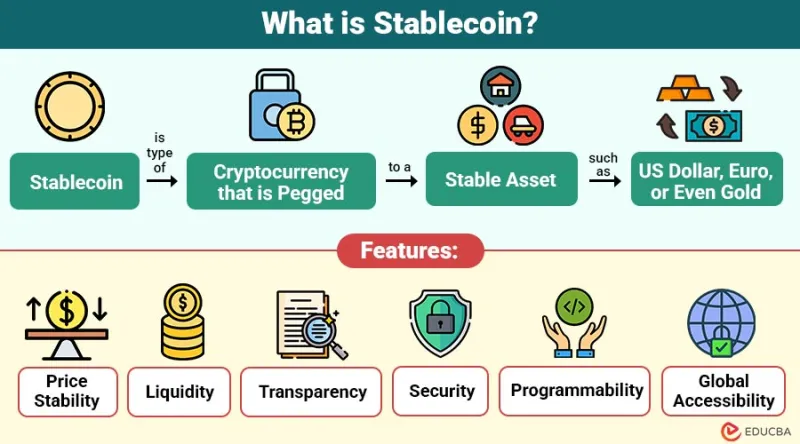
Photo: stablecoin digital currency shield protection financial stability crypto portfolio, via cdn.educba.com
In the summer of 2022, as Bitcoin shed more than 70 percent of its value from its November 2021 peak, a particular category of investor found themselves in an enviable position. They had not predicted the crash. They had not shorted the market. They had simply — and deliberately — rotated a meaningful portion of their holdings into stablecoins weeks earlier, when on-chain metrics and macroeconomic signals began flashing caution. When the capitulation arrived, they held dry powder while others held losses.
This is not a story about market timing in the conventional sense. It is a story about asset allocation — specifically, the underappreciated role that stablecoins can play as a tactical instrument rather than a passive holding pattern.
Rethinking Stablecoins Beyond the Waiting Room
The prevailing mental model for stablecoins among retail investors is straightforward: they are a place to park funds temporarily, a digital equivalent of cash sitting in a brokerage account. While this framing is not wrong, it is incomplete.
Experienced portfolio managers treat stablecoins as a dynamic allocation — one that can be increased or decreased in response to evolving market conditions, risk assessments, and opportunity analysis. In this framework, moving into USDC or USDT is not an admission of defeat or uncertainty. It is a deliberate act of capital preservation with a clear re-deployment thesis attached.
The distinction matters enormously for investor psychology. Framing a stablecoin allocation as "stepping aside strategically" rather than "missing out" changes the emotional calculus of the decision and makes it easier to execute without second-guessing.
Identifying the Signals That Justify a Defensive Rotation
No indicator is infallible, and no trader should expect to call tops or bottoms with precision. However, several frameworks can inform a rational decision to increase stablecoin exposure.
On-Chain Metrics: The Bitcoin Fear and Greed Index, exchange inflow volumes, and the MVRV ratio (which compares Bitcoin's market capitalization to its realized value) have historically provided meaningful signals when the market is overheated. Sustained readings in "Extreme Greed" territory, combined with rising exchange inflows, often precede corrections.
Macroeconomic Context: Crypto assets have demonstrated increasing sensitivity to Federal Reserve policy, inflation data, and credit conditions since 2021. When the broader US economic environment shifts toward tightening — rising interest rates, declining liquidity — risk assets including crypto have historically underperformed. Monitoring macro developments is no longer optional for serious digital asset investors.
Technical Structure: When major assets like Bitcoin or Ethereum break below key long-term moving averages and fail to reclaim them, the probability of extended downside increases. This is not a trigger for immediate full liquidation, but it is a reasonable basis for gradually increasing defensive allocations.
Portfolio Drawdown Thresholds: A rules-based approach can remove emotion from the decision entirely. Some traders establish a personal protocol: if the portfolio declines by a defined percentage from its recent high, stablecoin allocation automatically increases to a predetermined level. This systematizes what is otherwise a psychologically difficult judgment call.
The Tax Reality for US Investors
Any discussion of stablecoin strategy for American investors must address the tax implications directly. The Internal Revenue Service treats cryptocurrency as property, which means that converting Bitcoin, Ethereum, or any other digital asset into a stablecoin is a taxable event — regardless of whether you ever convert to US dollars.
If you purchased Bitcoin at $20,000 and rotate it into USDC at $60,000, you have realized a capital gain of $40,000 per coin. That gain is subject to either short-term or long-term capital gains tax rates depending on your holding period. For assets held less than one year, the short-term rate applies — taxed as ordinary income, which can reach 37 percent for high earners.
This does not mean defensive rotation is inadvisable. It means it must be planned with tax awareness. Several practical approaches are worth considering:
- Tax-loss harvesting: If you hold positions with unrealized losses elsewhere in your portfolio, realizing those losses simultaneously can offset gains from your defensive rotation.
- Holding period awareness: Where possible, timing rotations to qualify for long-term capital gains treatment (assets held more than one year) can meaningfully reduce the tax burden.
- Consulting a qualified tax professional: The intersection of crypto taxation and portfolio strategy is complex enough that professional guidance is genuinely valuable, not merely a formality.
Re-Entry: The Discipline of Buying Back In
The second half of a stablecoin strategy — re-entering the market — is where many investors stumble. Having successfully preserved capital through a downturn, the psychological challenge shifts. Fear of re-entering too early competes with fear of missing the recovery rally. The result, for many, is paralysis: they watch prices rise from the sidelines, waiting for a confirmation that never feels quite sufficient.
Two approaches can mitigate this tendency.
Dollar-Cost Averaging Back In: Rather than attempting to identify the precise bottom, deploy stablecoin reserves incrementally over a defined period — weekly or bi-weekly purchases at predetermined intervals. This approach sacrifices the theoretical maximum gain of a perfect bottom call in exchange for a far more achievable average entry price and the psychological relief of a systematic process.
Catalyst-Based Re-Entry: Define in advance what conditions would justify re-deployment. This might include a sustained reclaim of a key moving average, a shift in the Fear and Greed Index from Extreme Fear toward Neutral, or a specific on-chain metric crossing a defined threshold. By establishing these criteria before the recovery begins, you remove the cognitive burden of making the decision in real time under emotional pressure.
Stablecoins as a Long-Term Portfolio Component
Beyond tactical deployment during downturns, a standing stablecoin allocation serves a structural purpose in a well-designed crypto portfolio. Maintaining a baseline position — even during bull markets — ensures that you always have capital available to act on unexpected opportunities: a sudden price dislocation, a new asset that warrants a position, or a market overreaction to short-term news.
This is the posture that professional allocators refer to as "staying liquid." In traditional finance, cash is king during corrections. In the digital asset ecosystem, stablecoins fulfill that role with the added advantage of remaining within the crypto rails — accessible instantly, without the delays or friction of fiat conversion.
At Exchange777, we view stablecoin strategy not as a retreat from the market, but as an expression of the same analytical rigor that drives any sound investment decision. Capital preserved in a downturn is capital available for the next opportunity. That is not passivity — it is preparation.